Unit 9-11
Artistry
Jeremy Joseph
About me:
I’m a guitarist/producer who works in a wide range genres. I’m hardworking, passionate, patient and determined. I taught myself how the play the guitar. I grew up listening to Classic rock and pop but since then i’ve widened my musical palette. I take inspiration from a wide variety of genres such as Hip-Hop, Alternative rock , Indie, Electro, Blues,Jazz and Soul.
Visual identity:

Fanbase:
My fanbase would probably be the type of people that listen to alternative music and that don’t care about lyrics.
Live performance: I have live performances in the college on the 2nd October, 17th October and 11th December.
Marketing: I plan to market my music through social media, twitter and instagram, by releasing snippets and updates on there.
Releases: Im planing to release two demos on Soundcloud by the end of the year and an EP by the end of March 2020
Inspirations:
- James Blake: His music is very minimalist but has a lot dynamics and he’s very experimental.
- J DIlla: His use of sampling.
- Jimi Hendrix: His style of mixing rhythm and lead guitar in his playing.
- RadioHead: Weird time signatures and odd sound scapes
- Led Zeppelin: Heavy blues and electrifying riffs.
In the future i would like to become a producer/A&R person and help guide artists towards their unique sound.
Demos
I Started this track by using a sample I had found online and chopped it so that I was a perfect loop. I then panned the piano far left because I wanted the track to slowly fill up the stereo landscape as it went on by adding guitars and other samples. I also added a vinyl plugin to make the sample sound. After I had the 4 bar loop I added some white noise over the piano and put a gate on it to give it some rhythm and on the right hand side I added a vocal sample, that I pitched down, in order to fill up the track a bit more. After this I started adding guitars into the track, which I recorded by plugging my guitar into an audio interface which allowed me to record the guitar into the DAW. I recorded the guitar the same way for all three tracks. I played many guitar parts for this track cause I wanted it to go from calm to hectic and then pack to calm. I used Guitar Rig to achieve the tones because it have tonnes of different audio effects for guitars, of which I mainly used reverb and delay. I also reversed a solo that I played at the end of the track to achieve the chaotic atmosphere and reinforced the solo with other reversed guitar parts panned differently to each other.
I built this track around a song (Caroline Crawford- A Lovesong For You) that was in 6/8. I sampled three parts from the song the strings the vocals and the loop you hear at the beginning.I started the beat in 6/8 and then flipped it to 4/4 for when the drums came in. I did this by first chopping up the samples into smaller increments and then put it into the sampler in logic (EXS24), which allowed me to manipulate the sample into 4/4 by using the piano roll (midi). after I had flipped all 3 samples into 4/4 I arranged the beat, added some boom bap drums, which was a J Dilla sample, and played two guitar parts over it. I kept the the guitar tone simple only adding amp modelling to them using Guitar Rig.
For this track I started with the slower section and branched out from there. This track consist of 4 sections, intro, chorus, verse, outro. The slower section, the verse, consists of Drums (kick, snare, Hi-hat, open hat), bass and guitar. I programmed the bass and drums in and played the guitar part. The interesting part of this section I feel is the contrast it has with the rest of the track. I achieved this by adding a lot of reverb to the drums and guitars and also by using stereo delays on the hi hats, open hats and guitars. I then went on to make chorus which uses the same chords as the verse but I turned them into power chords and changed the drums to a very simple pattern in contrast to the complex pattern of the verse. I also changed the guitars to a more distorted tone using Guitar rig. after completing these two sections I went on to make the confusing intro. I wanted the intro to be confusing so that the chorus would hit harder when it dropped. for the intro I used a much cleaner tone on guitar rig and recorded many different guitar parts which where all panned in different directions. I didn’t focus too much on tempo or rhythm or key I just played some random notes and then a chord to mark the beginning of the track. For the outro I tuned down an open string so it could ring out whilst I was following the chords of the song but I switched the progression so that it would ascend and descend in pitch giving the effect of a rise and fall of tension which I think worked well with the song.
Feedback from my peers


Feedback I’ve given to my peers


October 2nd and 17th.
Rehearsal logs for the performance on the 2nd and 17th of October
18/09/19
In our first rehearsal we chose our two songs Ivy by Frank Ocean and On My Mind by Jorja Smith. I printed out the lyrics and chords for both songs at the library and then we started working on the verse and chorus for Ivy. By the end of the first rehearsal we had learnt the first half of the song.
25/09/19
Between the time of our first rehearsal and this rehearsal I learnt the chords to Jorja Smith’s On My Mind but during this rehearsal we decided to pick an easier song to play because we were worried we might not have enough time to be able to play the song to a high enough standard, so we changed On my mind by Jorja Smith to Hourglass by Catfish and the Bottleman.
02/09/19
This was our last rehearsal before our busking performance. During this rehearsal we managed to learn the whole of Hourglass and practised it over and over again so that we were all in sync with each other and that the transitions between the chorus and the bridge was smooth. In this rehearsal we decided to only perform Hourglass since it was the only sing we knew entirely.
Peer and tutor feedback
During these rehearsals some of the feedback from peers and tutors were:
- Work on combing the vocals and guitar,
- Add some variation to the strumming/picking pattern in order for it to not be boring,
- Stick to the songs you chose at the beginning,
Busking Evaluation
On the 2nd of October we did our Busking performance in the cafeteria. Te performed the song Hourglass by Catfish and the Bottleman. The performance went well and we managed to complete the song with few mistakes. Me and Imran played guitar (me playing lead and Imran playing rhythm) and Enya sung. The performance went well because we rehearsed the song a lot. I prepared myself for this performance by learning the chords and riffs to hourglass before rehearsals, this helped speed up the process of learning the song as a group.
We should’ve spent more time picking the songs at the beginning so that we don’t have to change the songs last minute. In the future to combat these issues i will:
- Spend more time on picking the song,
- Create a rehearsal plan so that i know what i should be practicing and when,
- Practise the song outside of rehearsal to the original version.
Resubmission Evaluation
We did our resubmission for the busking performance on the 17th of October and performed ‘Hourglass’ by Catfish and the Bottleman and Paparazzi by Lady Gaga. Since the last performance we had two rehearsals. One on the 16th and one the day of. We only practised Paparazzi during our rehearsals because we had to learn the song quickly. Me and Imran both played rhythm guitar for Paparazzi.
The performance went well, we managed to perform both songs with only a few mistakes.
December 11th
Improvement List:
Guitar technique: learn how to mix lead and rhythm guitar playing.
Harmonic Functions: learn the functions of chords in chord progressions.
Rehearsal Logs For the performance on the 11th of December
Week 1
We chose three song to cover for the live performance on the 11th of December, The less I know the better by Tame impala, Mardy bum by Artic Monkeys and Waiting on the world to change by John Mayer. After choosing three songs we wrote out the structure of the songs and how many bars where in each part. Outside of rehearsals I learnt the chord progression to The less I know the better.
Week 2
I was sick so i wasn’t in for rehearsals this week. Outside of rehearsals i rehearsed the less i know the better by playing along with the original version and i also learned the second guitar part.
Week 3
This week we rehearsed Mardy bum and Waiting on the world to change. We managed to get through half of both songs. We need to learn each song completely individually.
Outside of rehearsals I learnt the whole of Waiting on the wold to change and Mary bum, including the solos. I learnt the solo from the live version of waiting on the world to change because it was more interesting.
Week 4
We didn’t have rehearsal this week because carrie wasn’t in. Outside of rehearsals i practised by playing along with the original versions. This allows me to rehearse the songs effectively and see which sections of songs i need to focus on more.
Week 5
This was our last rehearsal and in this rehearsal we rehearsed waiting on the world to change by John Mayer, Mardy Bum by Arctic monkeys and we changed The less you know the better to Creep by Radiohead because we all already knew it and it was easier and more manageable for all of us. At home I rehearsed creep because I would only have one week to learn it completely.
Peer and tutor feedback
During these rehearsals some of the feedback from peers and tutors were:
- Increase volume of guitar when playing solos,
- Practise transitions between chorus and verses,
- Adjust tone of guitar to fit the overal tone of the song,
Christmas gig evaluation
On the 11th of December we performed three songs Mardy Bum by Arctic Monkeys, Creep by Radiohead and waiting on the world to change by John Mayer. I think that I performed the songs to a good level and the rest played very well, we performed well because we rehearsed a lot and I practised a lot at home. The gig was very well setup except sometimes I had trouble hearing myself.
If I was to look back and reflect on this gig I would say it was everyones best performance and i am happy with how much I practised.
Action plan
Wednesday: Rehearse, Start research on what on the improvement list above.
Thursday: Practice the solo to Mardy bum and waiting on the world to change for 30 mins.
Friday: Research Harmonic Functions.
Saturday: Practice The less i know the better for 30 mins.
Sunday: Research Harmonic theory.
Monday: Start writing dissertation.
Tuesday: finish off dissertation.
Wednesday: Practice all three of the songs one last time.
Exploration of specialist study and context
https://www.bbc.co.uk/bitesize/guides/z8tsh39/revision/1
Plan for presenting my specialist study:
- Perform a live presentation.
- Use the the sources above to Guide my presentation.
- Read through dissertation.
- Before hand write down some notes and talking points so not to get side tracked.
- Maybe use a piano or guitar to demonstrate the theory.
Topics:
- Chords
- Harmonic theory
- Song analysis
Chords
Chords are the foundation of most songs and most songs contain chords because of this. It is important to understand how chords are made and how they function because of the vital role they play in music. Whether its providing context to the melody or creating an emotion.
Chords are made up of three or more notes with set intervals and are split into four main categories: Major, minor, augmented and diminished.
Harmonic Theory
Harmonic theory has many different names like functional harmony and chord theory. It describes the how chords function within a chord progression and their different roles. There are many different theories on this but they all just slight variations of each other.
It usually splits up chords into 3 different groups Tonic, Sub dominant and dominant. The tonic chord is the home of the chord progression and is where the progression has zero tension the sub dominant want to pull you towards the dominant and the dominant wants to resolve to the tonic ie home. Keep in mind this is a very simplified version of the theory.
Dissertation
In this dissertation I will be looking into and analysing Harmonic Functions and Jimi Hendrix’s style of playing guitar, mixing lead and rhythm guitar. I chose these two subjects because this is what I am interested and passionate about and I believe that understanding these subjects will help me improve as a musician.
Harmonic Functions
Harmonic Function in music is the term used to describe the relationship between chords in a chord progression or a scale degree, which describes the position of a note in a scale, to a tonal degree. But to understand the relationships between chords and their functions within a chord progression, you first need to understand how and what a chord is made up of.
Chords
Chords are made up of three notes or more, but i’ll only be talking about basic chords which only contain three notes so that you have enough understanding of chords in order to grasp harmonic functions. Ill will be discussing how major, minor, diminished and augmented are made and the intervals they contain. Chords have two parts to them: The root note0 which is the first note of the chord, but not always, and the chord quality which tells you what the other notes in the chord are. The chord quality tells you the intervals within a chord and intervals are measured in whole and half steps, for example a whole step is C to D and a half step is C to C#. This is used to measure the distance between notes. In a chord any two notes must be at least a minor third apart from each other and cannot be more than a major third away from each other. I will be using the root note of F to explain how the following chords are made up and the intervals within them. A major chord is made up of the root note, which in our case is F, the major third, which is two whole steps from the root note A since we are using F as our root note and a perfect fifth, which is three whole steps and a half step from the root note which is C. A minor chord is made up of the root note, F, a minor third, which is a half step less than a major third so a whole step and a half step and a perfect fifth, C. Those two chords are the most common chord types but you’ll also need to know about a diminished and augmented chord. A diminished chord is made up of the root, F, A diminished fifth, B, which is a half step less than a perfect fifth (three whole steps) and a minor third, A flat, because its the only interval that fits, a major third is too close to the diminished fifth to work. Lastly an Augmented chord is made up of the root note, F, an augmented fifth, C#, which is a half step more than a perfect fifth (four whole steps) and a major third, A, because its the only internal that fits, a minor third is too far from the augmented fifth to work. [1]
Functional harmony
Now that you understand how chords are made and the different types of chords we can move on to harmonic function which is how chords function in a chord progression. To explain Functional harmony I will use C major and its diatonic chords (the chords that are derived from the notes of a key) as an example.
C major scale

All the the diatonic chords of a key have a function and by function I mean its job in a chord progression. Broadly there are three functions: Tonic, Sub dominant and Dominant. The Tonic chords are the I, VI and III chord, these are the chords in the scale that feel at home because they have zero tension. In the C major scale the tonic chords are C major, A minor and E minor. The Dominant chords are V and VII, these chords naturally resolve to the tonic so their function is to take us back home. In the C major scale the dominant chords are G major and B diminished. Finally the Subdominant chords are the II and IV, they lead you to the dominant. For the c major scale the subdominant chords are D minor and F major. [2]
Their are two main theories behind functional harmony. But both theories take inspiration from Jean-Phillippe Rameau’s Traité d’harmonie of 1722. The German functional theory and The Viennesse theory of the degrees.
The German Functional theory
Created by Hugo Riemann in 1893, the theory is called the theory of functions. It originates from Germany and is still used in German speaking countries and in North and East-European countries. It involves three tonal functions: Tonic, dominant and subdominant which are written as T, D, and S. Each of which could take on a more or less modified function in any chord of the scale. The theory outlines three abstract functions, the tonic, the dominant (its upper fifth) and the subdominant (its lower fifth). In addition he believes that the minor scale was the inversion of the major one. In 1903 D’Indy summarised the theory in three points: There is only one chord, a perfect chord; it alone is consonant because it alone generates a feeling of repose and balance, this chord has two different forms, major and minor, depending whether the chord is composed of a minor third over a major third, or a major third over a minor and last of all this chord is able to take on three different harmonic functions, tonic dominant or subdominant. Despite how confusing this theory is, his ideas had a significant impact. [4]
The Viennesse theory of the degrees
Created by Simon Sechter, Heinrich Schenker and Arnold Schoenberg among others. This theory as opposed to the German theory this describes the relation of the chord to their tonic in the context of harmonic progressions mostly following the circle of fifths. This theory is still commonly practised in Western Europe and the United States. The idea is that each degree has its own function and refers to the tonal centre through the circle of fifths. It emphasises harmonic progressions above chord quality. There are seven different functions, these are Tonic, Supertonic, Mediant, Subdominant, Dominant, Submediant and Leading tone. Using the C Major scale and its diatonic chords like last time i’ll explain these seven functions. The Tonic is I (C) and is home, the Supertonic is the ii (Dmin) and naturally resolves to a chord with a dominant function, the Mediant is the iii (Emin) it functions as a very weak Subdominant (its rarely used), the Subdominant is the IV (F) and leads you towards the dominant, the dominant is the V (G) and naturally resolves to the Tonic the I (C), the submediant is the vi (Amin) its a weak Subdominant and most commonly leads from the Tonic to Subdominant and lastly the Leading tone is the vii° (Bdim) it has several functions, either used as a passing chord or as a incomplete dominant seventh chord. [5]
Cadences
A cadence is a chord progression with at least two chords that ends the progression or phrase within a piece of music. There are four main cadences of which two sound finished (resolved) and two sound unfinished (Unresolved).
Finished cadences
Both of the finished cadences sound resolved because they end on the I chord, the home of the key.
Authentic cadences or perfect cadence
Is when it goes from the V to I and is the cadence that sounds the most finished (resolved).
Plagal cadence
This cadence goes from IV to I. Its sometimes referred to as the Amen cadence because in most traditional hymns its set to the “amen”.
Unfinished cadences
Unfinished cadences sound unfinished because they don’t end on the I. when you hear it at the end of a progression its unresolved which leads it sounding unfinished and sounds like it should end there, as if it should continue onto another section.
Half or Imperfect cadence
Ends on the V chord. It can only start on the I, II or IV and sounds unfinished.
Interrupted cadence (deceptive cadence)
Ends on an unexpected chord, sounds like its being interrupted. The most common form of this would be from V to VI. [3]
Jimi Hendrix’s Style of playing guitar
For this part of the dissertation I wanted to analyse Jimi Hendrix’s guitar playing style and see what made it so amazingly unique.
Johnny Allen Hendrix or more commonly known as Jimi Hendrix, was a psychedelic rock musician from the 1960-70, who is widely regarded as one on the best guitarists of all time. He started by backing artist such as Little Richard, B.B. King and Ike and Tina Turner working under the name Jimmy James. But in 1966 he moved to London and started a band called the Jimi Hendrix Experience with which he released numerous albums. Jimi Hendrix is known for his distinctive style mixing lead and rhythm guitar together. His rhythm guitar playing derives heavily from Funk using a jazz chords and a lot of syncopation. Whereas his lead guitar playing is very Blues orientated using primarily the minor pentatonic scale. Because of this Jimi’s style was very dynamic and groovy. He would often arpeggiate chords, rarely letting the whole chord ring out, and would embellish chords very often which is how he would mix between lead and rhythm. His songs often contained very intricate parts that are very difficult to play. [6]
In summary Chords are made up of three notes or more with specific intervals. Functional harmony can be viewed in many different ways but what is definite is that all the degrees in a scale have a specific function and lastly Jimi Hendrix used his influence of funk and blues create a new guitar style which mixes lead and rhythm guitar playing.
Funding Application
I believe that music is a very important tool in a child’s development, as it encourages creativity and independent thinking. For this reason I would like to get funding in order to start a workshop aimed at teaching children from the ages of 9-15 how to play guitar. Doing this as a group would be stimulating as it would encourage them to explore the way the instrument works and how to utilise proper technique. This would benefit the community as it would be a safe place for kids to explore their creativity and share their cultural backgrounds together. I would provide the guitars and other equipment necessary for the workshop. The workshop would be run for an hour twice a week for 2 months.
I would use the Arts council funding to fund the project as it funds other project like this. Using the National lottery project grants I would need a grant of £458. This would Cover the costs of the Venue for 2 months (£208), the costs of 5 acoustic guitars (£250) and would use instagram to advertise the workshop.
References
[1] How Basic Chords Work – Music Theory Lesson 1 (2011). How Basic Chords Work – Music Theory Lesson 1. [online] YouTube. Available at: https://youtu.be/5Y01jIorpeA [Accessed 6 Feb. 2020].
[2] harmony, (2017). Chord theory epic: functional harmony, secondary dominants, substitutions and diminished 7ths. [online] YouTube. Available at: https://youtu.be/AYBQUvmhAX8.
[3] Music Theory Academy (2019). Cadences – Music Theory Academy. [online] Musictheoryacademy.com. Available at: https://www.musictheoryacademy.com/how-to-read-sheet-music/cadences/.
[4] Riemann, H. (n.d.). Harmony Simplified or the Theory of Tonal Functions of Chords.
[5] Wason, R.E. (1982). Viennese Harmonic Theory.
[6] GP Staff (2019). Jimi Hendrix: The Five Rules of His Powerful Rhythm Style. [online] GuitarPlayer.com. Available at: https://www.guitarplayer.com/technique/jimi-hendrix-the-five-rules-of-his-powerful-rhythm-style-tab-audio [Accessed 6 Feb. 2020].
Drum Programming
How I made the track
I used the EXS24 to program the drums and used some samples I had previously downloaded for the rest. I Created a summing track to add compression to the drums and I side chained the kick to the:
- Background noise
- Guitar
- Crash cymbal
UCAS (Unit 10)
Why should/shouldn’t you go to university:
Should:
- Necessary in certain career paths,
- Unique life experiences,
- Makes for a better CV,
- Allows you to specialise in a subject,
- Often leads to a better career in the future,
- Helps develop transferable skills,
Shouldn’t:
- Its expensive,
- For certain career paths there are better alternatives,
- Its not needed for certain career paths,
- You aren’t guaranteed a job with a degree,
- You’ll finish the degree in debt,
What am I looking for In a course?
- Focussed primarily on Music Production,
- Also Music business,
- Mostly practical work when it comes to music production,
- In England,
- Preferably not too far from London,
- Modern approach to music production and business,
- A wide range of genres included in production,
- Be able to transfer into the music industry after the end of the course,
- Professional equipment available,
5 Courses I’m interested in and Why:
- University of Kent – Music Business and Production – BA (Hons)
https://www.kent.ac.uk/courses/undergraduate/2505/music-business-production#structure
- Includes Music Business and Production,
- Possible to take a year placement in the industry,
- State-of-the-art technology from leading manufacturers,
2. BIMM London – Music and Sound Production – BA (Hons)
https://www.bimm.ac.uk/study/courses/london/music-production/ba-hons-music-production-ln/
- Hands-on learning,
- London,
- Allows you to pursue a wide range of music industry roles,
3. Leeds College of Music – Music Production – BA (Hons)
- Masterclasses by industry professionals,
- Opportunity to collaborate with musicians from multiple genres,
- Performance opportunities,
4. Point Blank Music School – Music Production & Sound Engineering Degree – BA (Hons)
- 2 year course,
- Taught by industry professionals,
- Small classes,
5. Solent University Southampton – Popular Music Production BSc (Hons)
https://www.solent.ac.uk/courses/undergraduate/popular-music-production-bsc
- Visit Abbey road studios and talk to top studio engineers,
- Close links with industry,
- Taught by active industry experts,
Personal statement
Should include:
- Strenghts
- Experience
- Hobbies
- Skills
- USP (unique selling point)
- What + why
- Extra curricular
- Achievements
First Draft:
When I was little my dad bought me a small acoustic guitar for my birthday and took me to lessons but I quit shortly after because I was more interested in playing football or Mario kart. But when I was 13 or 14 I started teaching myself to play guitar and ever since I’ve been addicted to it. This has lead to me listening to more music in order to find new songs/riffs to learn and play. I’ve been playing for 3-4 years now and my passion for it hasn’t changed, the more I learn the more I realise how much more there is to learn. I never really knew what I wanted to do until I started playing guitar and ever since I’ve known that I want to create/ produce music for other people or even for myself.
I used to be quite athletic playing a multitude of sports like football, rugby, tennis, judo and many more from a young age which made me a competitive person but over the years of playing sports especially playing both team and individual sports has taught me lots of transferable skills such as team work, discipline and leadership skills.
Apart from music I like maths, history and art.
I was also a part of the school choir singing catholic hymns during school masses. Though I cannot sing like I used to this taught me punctuality since our music teacher was extremely strict and would shout at us if we were late or messing around during rehearsals.
Second Draft:
Music has been a passion of mine for the past five years. I’m a self-taught guitarist and have been playing for three years. I started playing guitar because I had lots of spare time and had nothing else to do, so I thought to myself “why not learn an instrument”. Whilst learning guitar I discovered different genres and artist that I had never listened to before, such as genres like Funk, Blues, Folk and artist like Jimi Hendrix, BB King and Radiohead. Upon hearing and experiencing all this new music I started to go to concerts and festivals with my friends and started a band with my neighbours, which taught me how to work in a team. I have learnt that people find happiness in all sorts of things such as family and friends, and for me music is one of those things. That is why i want to use my genuine passion to further my higher education as well as perusing a career in this field
I took this course because I know that in the future I would like to work somewhere within the music industry, whether that is as a producer or as an Artists and Repertoire representative. University will provide me with the opportunity to further my learning and deepen my understanding of the music industry. Preparing me for my future career in this sector. I understand that because of the way we consume music now through streaming that the people in the music industry are struggling and also due to it being heavily saturated, but I still want to pursue a career in the music industry because it is what I enjoy and am passionate about.
Studying Music at college has taught me about the culture’s music genres come from such as Reggae and the Rastafarian culture. I think it’s important to understand the underlying culture of the music because it gives you a deeper understanding of the music and where it comes from, especially since we live in such globalised world where language and culture have no barriers. Example of the rise of K-Pop in the west.
Final Draft:
Music is a true passion of mine. I am a self-taught musician and have been playing guitar for the past four years. Learning an instrument has taught me skills I would not have had otherwise.
These are skills I transfer into my learning and potential career. When I am not working on college course work, I like to produce my own music at home and some weekend me and my friends meet up to make songs which I produce. We are currently working on an EP. I believe this has improved my skills both working independently and in a group.
My current course, Music Production and Performance, has been an introduction into the theoretical side of music. I am applying to university to further develop my knowledge of music within academia. Furthermore, studying music at a higher level would allow my technical skills to improve to a professional standard, that would be required in order to enter this industry. For instance, acquiring a deeper understanding of how the music industry functions in today’s society would set me up for a future career, whether this be as a freelancer or working within an organisation.
The way we consume music now, through streaming services, has meant that musicians and those working within the music industry are struggling. Despite the internet being a platform that in theory allows equal access for all individuals to share their art, it has affected the remuneration of musicians and how record labels make their money. Sources of income for those in this sector have become increasingly saturated. For this reason, a deeper insight of the way business affects the music industry is vital not only for today but for the future and because of this I would like to learn more about how this industry functions.
In addition to how the internet is causing profound changes in the music industry, it is important to consider its global reach. This has led to music from the East, such as K-Pop, to top the charts in the West. The immersion of non-traditional western music has encouraged multi-cultural collaborations. This new wave of globalisation within music means that audiences now have a much wider palette of music than ever before.
From a production perspective, it is important to understand the underlying culture of the music as it is rooted within the context of the sound. Genres are no longer as defined as they once were, with cross-cultural influences being the norm and more accepted by Western listeners. Producers who are not bound by genre or culture have a certain advantage over others, in such a competitive field. This skill allows these producers to work with artists across the globe, which is becoming a more and more common nowadays. Extending my skills as a producer and having more experience with music from other cultures would be important as this is where I believe the industry is heading.
To conclude, having the opportunity to further study music at university would equip me with invaluable knowledge, skill and experience to succeed within the industry. I am motivated, hardworking and wanting to pursue a career in this industry. I believe that those combined with my willingness to learn and enthusiasm makes me a strong candidate.
Communication in industry
How effective are they?
NME – https://www.nme.com/news/music
This method method of communication allows the music to reach a large and broad audience because NME covers a wide range of music from hip hop to metal. It has also been around for a long time so it already has a lot of people reading so it’s a guaranteed way of reaching a lot of people compared to the other two.
Music blog – https://www.wepluggoodmusic.com
This method is good for artists who have a very niche sound. Usually music blogs are very specific with the type of music they talk about. This allows the artist to promote their music to people that are more likely to enjoy/listen to the type of music the blog writes about. Compared to the other two this one reaches the least amount of people but it is the most targeted.
Social media – https://twitter.com/Craggz_Battery
This is by far the most effective way of promoting music. It is very important nowadays for artists to have a social media presence in order to promote their music. If you are already very successful and have a large following on social media then it is a free way of promoting your music. For artists that don’t have as large of a following it is a great way to communicate and interact with your fans. Out of all three methods I think that this is the most effective and also the most important.
Class notes
Mastering – is altering mixing and it fixes up the finer details of the track. Its very important like mixing.
Limiter – is a compressor with a really high ratio that limits gains of peaks so that your audio doesn’t clip/distort.
Brickwall effect – is when when there aren’t any dynamics in the audio and audio looks like square this is caused by limiters
Multiple compressors help even out the load
Really good soundcard/audio interface + any DAW = as good as sound quality as protools
Noise Gate – cuts off when audio reaches below the threshold set in parameters
I/O – allows you to transfer analog audio effects to digital
VCA: voltage controlled amplifier
Noise flow – sound of room, bleed ect…
Gain reduction – regulates amplitude in order to keep the signal from not peaking or being too loud
Overcompression – when an audio signal is too compressed (sometimes a good thing)
Threshold – is at what gain the compressor starts working
Attack – when the compressor starts working works in milliseconds (ms)
Knee – How aggressive the compression is
Release – is when you want the compression to let go of the signal.
Compression
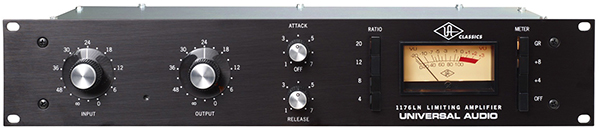
Compression essentially is an Automatic Volume Control. before compression a mix engineer would have to manually control the volume using the faders, adjusting according to how loud or quiet the singer was singing in order to get clear vocals out of a performance. Compression is used very often in the process of mixing.
Parameters
Compressors can only lower sounds but it can also allow you to lift the overall sound up, reducing the overall dynamic range of a sound. Most compressors have the same parameters.
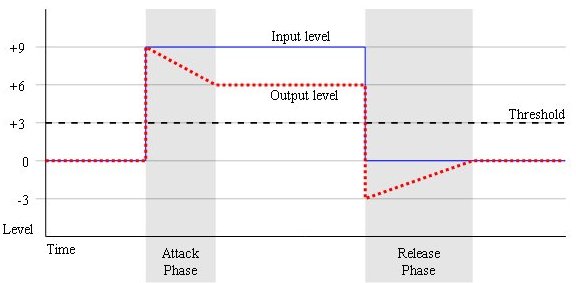
Threshold: Threshold is at what level (dB) the compressor will start to effect the signal at. Usually its set just above the quiet section of the audio you want to compress. If the signal goes above the set signal it will be turned down in volume.

Ratio: Ratio is the strength of the compression, ie how much the the compressor will reduce the signal above the threshold by. For example a ratio of 10:1 will reduce a signal of 10dBs over the threshold to a signal 1dB over the threshold. Ratios of 10:1 and above are classed as Limiting which means that they hardly let the signal go above the threshold and are often used for stopping the signal to go over Zero dB on the Master Fader

Attack: Attack is the time (ms) it takes for the compressor to reduce the signals amplitude. Attack is used to control the dynamics of the sound. To reduce the punch of a sound go for a fast attack and to increase the punch of a sound use a slower attack.
Release: Release is the time it takes for the compressor to return to the normal level after compressing the signal, ie how long it takes for the compressor to let go of the signal. With too short of a release time you will get a pumping and breathing sound, this effect is used in some modern electronic genres. Too long a release the compressor will be compressing signals under the threshold. Auto release makes it so the computer automatically adjusts the release depending on the sound coming into the compressor.
Peak or RMS
Some compressors have two modes when compressing, Peak or RMS. They both have their own characteristics and will decide how the compressor reacts to the signal.
RMS: Root Mean Square responds to an average signal level. It is the gentler modes of the two and is suited for vocals and instruments.
Peak: Peak responds to immediate volume levels and is the more aggressive of the two. It’s Suited for Drums and Percussion and when at a high ratios works as a Limiter.
Knee
Knee determines how the compressor reacts to the signal once it goes above the threshold. A Soft Knee (low) is used with high ratios and if you don’t want your limiter to be too aggressive. A Hard Knee (high) is used if you want an immediate or fast reaction to busy material such as Drums and Percussion.
Gain Reduction Meter
The gain reduction meter gives you a visual representation of how much the signal is being reduced in dBs. Its very useful and allows you too gage exactly how many dBs the compressor is reducing the signal so you can, if needed, increase the post compression (makeup) gain to an optimal level.
Summative Evaluation
Unit 9:For this unit we had to do two live performances, an artistry description and studio demos.
The first live performance was a busking performance, we had to do it twice because the first attempt was not up to level 3 standard. This was because we kept changing one of the songs which resulted in us not having enough time to learn the song properly. When It came round to the resubmission we were fully prepared and performed well on the day. This taught us to keep to the songs that we picked and communicate better as a group so that it is clear what we are rehearsing and what song we are performing. The second performance went a lot better. It was in a gig environment with a very professional set up. We performed three songs to a high level and ran into very few complications because we learnt from our past mistakes and actively tried to avoid making the same mistakes again. The skills that I have learnt from these performances and rehearsals like communication, team work and discipline will be vital if I was to pursue a career as a musician but are also transferable skills that I can use in my day to day life.
For the artistry I wrote about myself, my inspirations, what I want to do in the future, current plans and upcoming gigs. Writing an artistry helped me reflect on myself and express out loud my future goals and ambitions, and because of that I now have a clearer understanding of who I am and what I want to do, which will allow me to better describe to others in the future.
Lastly I did three studio demos, where I was free to make what ever type of music I wanted to. Having this type of freedom allowed me to explore producing in different genres and see what my likes and dislikes when it come to producing and composing original music. Knowing this will help me in making my own path in order to find my own sound.
Unit 10: This unit comprised of UCAS submission (for those planning on going to uni), Personal statement, mock interview and an analysis on the different types of communication within the industry.
Writing a personal statement was difficult because I wasn’t sure how to start it and how to fit everything in that I wanted to say into small condensed paragraphs, but once I started writing it and getting into a flow it became much easier and more natural. Making different drafts allowed me to refine the personal statement and I also got family members and friends to read over it and give constructive criticism in order to improve my personal statement.
I found the mock interview difficult because I’m not very good at selling myself but it’s important to learn how to conduct yourself during an interview, understand the subtext behind the questions asked and how to properly answer those questions. After completing this section I have acquired the necessary tools for an interview, which will be very useful because I will be attending many interviews in the future.
I enjoyed researching the different types of communication within the industry and finding out the different ways artist and record labels promote music. This will be useful information for the future if I study music business at uni as I will already have a basic understanding of the promotional side of the industry.
Unit 11: The final unit of this section consisted of an Exploration of a specialist study, a Dissertation and a funding application.
The exploration of a specialist study was based on what I wrote in my dissertation and was put in the format of a live presentation. This helped as being a precursor to what i’ll be doing for my final major project and helped expand my music theory knowledge, which will be useful for composing original music in the future.
The dissertation took a lot of time to write and involved lots of research beforehand. Doing the dissertation at the last minute taught me that I should plan ahead and not just leave it to the last minute, but I am happy with how it turned out and am looking forward to continuing on with harmonic theory for my final major project.
The funding application was interesting to work on and required some research into how to apply. This knowledge will come in handy for if I ever need to apply for a grant In the future.
 Jeremy's Music Blog