Week 1
Research
Tonal harmony:
- Uses major and minor keys.
- Has a tonal centre.
- Uses functional harmony.
- Very prevalent in pop music (I, IV, V and vi)
Example: Leonard Cohen – Hallelujah
Modal harmony:
- Uses all modes, No functioning harmony, tonal centre.
- Chords do not feel like they need to resolve to the tonic. Each chord just floats there by itself as a standalone entity.
- There is a tonal centre
- Can’t use dominant chords to establish tonic
- Can use pedal point (repeat root note) and ostinato (repetitive pattern)
- Modal harmony is more ambiguous or vague, gives the soloist more freedom and choice.
- Quartal chords sound more modal.
Example: Miles Davis – So what
Atonal harmony:
- No chord is inherently functional (non functional).
- No tonal centre.
- Not in any single key (non diatonic).
- Voice leading connects the progression.
- Atonal music lack the feeling of harmonic tension and resolution.
Example: Bill Evans – Time remembered
Cadences
V – I Perfect cadence: Dominant to Tonic.
V – vi Deceptive cadence: Dominant to chord other than the Tonic.
? – V Half Cadence: Any cadence ending on the dominant regardless of which chord proceeds it. Chord progressions rarely end on a half cadence (sounds unfinished).
IV – I Plagal Cadence: Subdominant to the Tonic, also known as the Amen cadence.
Circle of Fifths
- How keys are related to each other.
- Map to find routes between different keys.
- Based on discoveries by Pythagorus.
- 12 semitones in an octave.
- helps find what key you’re in.
- helps find relative major/minor keys.
- helps find available chords in a key.
- Useful for transposing music into a different key.
- Useful for moving between keys within a song.
Its called the circle of fifths because as you move around the circle (clockwise), the next note you encounter is a fifth above the note before it.
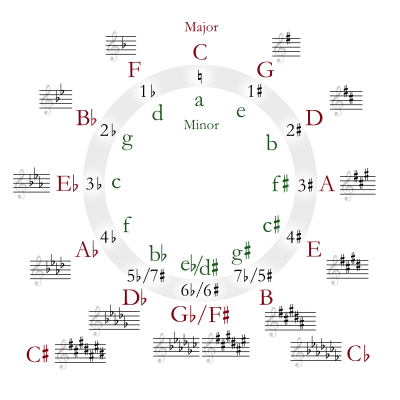
C is at the twelfth position cause it has no sharps or flats which makes it a good starting point on the circle of fifths. From their going clockwise or anticlockwise you can see how many sharps or flats the key has. Usually the circle is written so that the sharps are only on the right and flats on the left.
Finding the Chords of the key
To tell what chords are available in a key signature, using C major as an example. we start at C since its in the name. Then we look at the chords adjacent on either side, which in this case is F and G. These will be the major chords in the key of C major. Then we carry on around the circle in a clockwise direction to the next three chords, which are D, A and E our minor chords. Continuing clockwise to B this is our diminished chord. So using this information we have found the chords to the C major scale: C, Dm, Em, F, G, Am, Bdim. This formula also shows you the relative minor, which in this case is A minor, and can also be used to find the chords for any other major or minor key.

The relative minor shares the same notes as its major relative but they’re just in a different order. For example the C major scale is C, Dm, Em, F, G, Am, Bdim and the A minor scale is Am, Bdim, C, Dm, Em, F, G.
https://randscullard.com/CircleOfFifths/
^The link above is to an interactive online circle of fifths.
Transposing using the circle of fifths
The circle of fifths can also be used to transpose chord progressions to other keys. this is done by moving clockwise or anticlockwise in steps around the circle. For example if wanted to transpose a ii – V – I in C major to D major.
- C would move clockwise by 2 steps to get to D
- Dm would move clockwise by 2 steps to get to Em
- G would move clockwise by 2 steps to get to A
So the chord progression would go from Dm – G – C to Em – A – D, which is now in the key signature of D major.
Modulation
The closer the keys are on the circle correlates to how similar the keys are, meaning the closer the keys are the easier it is modulating from one to the other. For example C major and G major have 4 chords in common, whereas C major and F# major have no chords in common.
Evaluation
The first week of the project went well. I managed to do a lot of research and completed my goals for the week. I decided to do some research into Atonal harmony and Modal harmony in order to be fully prepared for the future weeks, where i’ll need to analyse songs. I also decided to research the circle of fifths so that I can use it as a tool to map out songs when it comes to analysing songs in the future. This will also allow me to explain my analysis in a way that is easier to digest when it comes to writing the scripts for the videos. When it comes to my research I could’ve improved it by gathering information from a wider range of sources, but by researching through videos and articles it allowed me to see how I could go about filming my videos. In conclusion I believe that this week was a strong start to the project and has given me a lot of confidence towards the project.
Notes
References for Week 1
Modern Jazz – Tonal vs Modal Harmony. (2016). YouTube. Available at: https://www.youtube.com/watch?v=OCkCn0dEgpw&feature=emb_title [Accessed 20 May 2020].
Modern Jazz – Atonal Harmony. (2017). YouTube. Available at: https://www.youtube.com/watch?v=Q_65MYImI-g&feature=emb_title [Accessed 20 May 2020].
The Circle of Fifths made clear. (2015). YouTube. Available at: https://www.youtube.com/watch?v=_UxzDjU3-hM&feature=emb_title [Accessed 20 May 2020].
The Circle of Fifths – Minor Keys and Advanced Uses. (2015). YouTube. Available at: https://www.youtube.com/watch?v=hzgDTocKyc4&feature=emb_title [Accessed 20 May 2020].
Musicnotes Now. (2019). Cadences in Music Theory: The 4 Types Explained. [online] Available at: https://www.musicnotes.com/now/tips/cadences-in-music-theory-the-4-types-explained/.
Taylor, E. (2008). The AB guide to music theory. London: The Associated Board Of The Royal Schools Of Music.
Week 2
Yesterday by the Beatles
- Key: F Major
- Time Signature: 4/4
Structure:
Intro (2 bars)
F |F ||
Verse (7 bars)
F |Em7, A7 |Dm, Dm/C7 |Bb, C7 |F, F/E |Dm7, G7 |Bb, F ||
Verse (7 bars)
F |Em7, A7 |Dm, Dm/C7 |Bb, C7 |F, F/E |Dm7, G7 |Bb, F ||
Bridge (8 bars)
Em7, A7 |Dm-C-Bb-Am |Gm, C|F || x2
Verse (7 bars)
F |Em7, A7 |Dm, Dm/C7 |Bb, C7 |F, F/E |Dm7, G7 |Bb, F ||
Bridge (8 bars)
Em7, A7 |Dm-C-Bb-Am |Gm, C|F || x2
Verse (7 bars)
F |Em7, A7 |Dm, Dm/C7 |Bb, C7 |F, F/E |Dm7, G7 |Bb, F ||
Outro (2 bars)
F, Gm |Bb, F ||
Song analysis
F major Scale: F, G, A, Bb, C, D, E
D minor Scale: D, E, F, G, A, Bb, C
Refer to Unit 12 to find the functions of the chords (Tonic, Subdominant, Dominant)
Intro
McCartney drones a F major chord without the major 3rd for two bars. This gives the beginning of the song an ambiguous tone and provides tension.
- Gives an empty feeling.
- Doesn’t feel like the I chord yet because of the lack of the major 3rd.
F |F ||
Verse
Starts on the I chord and quickly modulates to the relative minor before F is established as being home. The D minor chord feels like the first instance of home because of the V to I perfect cadence and the E minor in-between the F and the A (V of D minor) is a chromatic decent to help transition the progression, but it is interesting to see a jump from F major to E minor so quickly. After the D minor chord the bass notes lead us to Bb (a subdominant chord) which wants to pull us toward the Dominant chord (C major) of the F major scale, which then resolves to the the tonic (F major) in a perfect cadence. The progression then descends to D minor (the relative minor) through the bass, which then transitions to G7 and Bb major for one last rise in tension before it resolves to the tonal centre (F major) by the use of a plagal cadence IV to I which isn’t as strong of a resolution as the perfect cadence.
- The verse is 7 bars long which means that when the bridge comes in on the 8th bar it is surprising and goes with the lyrics.
- The verse is fighting between major and minor
F |Em7, A7 |Dm, Dm/C7 |Bb, C7 |F, F/E |Dm7, G7 |Bb, F ||
Bridge
Bridge section gives a strong feeling of F major being the Tonal centre of the song as the progression has a strong resolution to F at the end, V to I. The progression is also descending in fifths from Em to F with the Bb in the 2 bar being a passing chord which helps cary the momentum of the the progression along.
Em7, A7 |Dm-C-Bb-Am |Gm, C|F || x2
Outro
This section just repeats the ending of the verse. This give the song a familiar and smooth ending as we’re familiar with the progression by now since we’ve heard the progression already throughout the duration of the song.
Dm, Gm|Bb, F ||
Evaluation
For the second week I achieved my goal of picking a song (Yesterday by the Beatles) and analysing the chord progression to see what makes it effective. Analysing the song also allowed me to practise piano and sharpen my skills, as I am not familiar with the piano yet. I learnt the different chords and how to properly position yourself whilst playing. This will be very useful in the future as I what to be a multi instrumentalist. I ran into some issues during the analysis like different websites transcribing the songs differently so i got over this by transcribing the song myself, by listening to the song and finding the chords on the piano. After I finished my transcription I compared it to the ones online to check for any difference and then changed mine according to which I believed to be more accurate. Transcribing the song myself trained my relative pitch and allowed for the transcription to be more faithful to the original. I analysed the song by using a combination of the information I had learnt during Unit 9-11 (writing the dissertation) and the further research I did during week 1. I ran into very few issues analysing the song, the only major issue was the presence of an Em which was a little confusing as it should be diminished not minor. I resolved this issue by doing some more research and getting other opinions from fellow musicians. In conclusion week 2 went very well with only just a couple minor issues that were easy to manage.
Notes
References for Week 2
How To Analyze Songs. (2018). YouTube. Available at: https://www.youtube.com/watch?v=rP6WrG_Nq9E&feature=emb_title [Accessed 20 May 2020].
Yesterday (Remastered 2009). (2018). YouTube. Available at: https://www.youtube.com/watch?v=NrgmdOz227I&feature=emb_title [Accessed 20 May 2020].
http://www.icce.rug.nl. (n.d.). Alan W. Pollack’s Notes on “Yesterday.” [online] Available at: http://www.icce.rug.nl/~soundscapes/DATABASES/AWP/y.shtml [Accessed 20 May 2020].
Week 3
Video Script / Ideas
Video should be anywhere between 5 to 10 minutes long.
First Draft
Intro Section:
- Maybe a skit
- Or a normal intro
Analysis:
The song is in F major but often goes to the relative minor of D minor.
The intro is 2 bars long and doesn’t have much going on harmonically to analyse just a F major chord (I chord) without the major 3rd. The lack of major 3rd gives the the chord an ambiguous tone, neither major nor minor. This is what makes the Intro sound suspenseful and emotionless.
*Show demonstrations for the specific sections you are talking about as you are talking about it.
The verse starts on the I chord (F major) and then quickly modulates to the relative minor through the chords Em and A7. D minor is the first instance of the feeling of home largely because of the perfect cadence (V to I). [also talk about the leap from F to Em and the descent in fifths]. The bass then leads you to Bb using C as a passing note. The Bb serves as a subdominant in this key and pulls us towards the Dominant in the key of f (C major), which then resolves to the tonic in a perfect cadence. F then goes to G7 and Bb to create a rise in tension before resolving back to F, which is a plagal cadence (IV to I). This cadence gives the feeling of resolution but not as strongly as the perfect cadence. This cadence is very effective in this situation because it gives the feeling of resolution but not as much as to stop the progression which is the sound I think McCartney was going for when he wrote the song. In addition the verse is only 7 bars long as pose to the standard 8 or 16, which makes the bridge more surprising.
*Show demonstrations for the specific sections you are talking about as you are talking about it.
The bridge section is very interesting as it starts on Em which in addition with the verse being 7 bars gives it the feeling that there is a bar missing. It the descends from Em in fifths to A7 and Dm (the relative minor). After that it goes to Bb which isn’t a fifth apart from Dm but helps us go to the Key of F major where we continue to descend in fifths with Gm, C and F being a fifth apart and C to F being a perfect cadence which gives this section a nice resolution, some would say perfect [wink at camera].
*Show demonstrations for the specific sections you are talking about as you are talking about it.
The Outro is just repeating same 4 chords as the last 2 bars of the verse. This gives the outro a very familiar feeling because we’ve already heard it before throughout the duration of the song.
*Show demonstrations for the specific sections you are talking about as you are talking about it.
Outro to the video:
Thank you for watching my analysis on the functional harmony behind Yesterday, keep in mind music is subjective and this is just my perspective on it.
How am I going to record it?
I am either going to use my phone camera or my mums camera.
I will test out the microphones of both the phone and the camera to see which one will be more suited.
How will I edit the videos?
I have iMovies on my MacBook which is a video editing software. But I will also do some research into other options and see which is the best for what I want to do.
Evaluation
My goals during week 3 was to write/plan out the video analysing Yesterday by the Beatles. Before this I had never written a script in my life so I has very curious to see how it would turn out. I also wanted to do some research into videos that were similar to what I am planning on doing, in order to get some inspiration on how I could present my analysis. The script went well although I would’ve hoped to be able to write more than just one draft. But I due to the Coronavirus I was not able to go into college and work on this with the help of my teachers and peers. I continued my work on the project from home which was more difficult as there is a lot more things to distract me from doing my work, which is why I think I only managed to write one draft. The draft is mostly just the analysis but as I write more I will start adding more jokes to it in order to make it more entertaining to watch. I also wrote down any ideas relating to the video that came to my head down so that I wouldn’t forget them and I will be reading them and seeing which ones I want to implement. I still need to test out how I will record the video and edit it but other than that I think that week 3 was decent in terms of how much work I managed to get done.
References for Week 3
Understanding Comfortably Numb. (2017). YouTube. Available at: https://www.youtube.com/watch?v=K6HCykbHtBM&feature=emb_title [Accessed 20 May 2020].
Music That Sounds Like The Lyrics. (2019). YouTube. Available at: https://www.youtube.com/watch?v=NMOMPMzR6oY&feature=emb_title [Accessed 20 May 2020].
http://www.seechord.co.uk. (n.d.). Secrets of The Beatles | SeeChord. [online] Available at: http://www.seechord.co.uk/song-writing/secrets-of-the-beatles/#Yesterday [Accessed 20 May 2020].
Week 4
Testing of different equipment.
This was to test and compare the audio quality of each camera. I came to the conclusion that the Canon camera had the best visual quality, which was expected, but also the best audio quality. Then comparing the MacBook to the iPhone I preferred the quality of the iPhone over the pixelated MacBook camera.
Camera Setup
This was the first set up. I used a tripod to get the camera in a position where only my hands and keyboard were in shot. I also put my notebook and computer out of shot incase I need the script or extra information. I ran into a lot of issues using the camera to record. Firstly I wasn’t too familiar with how to work the camera so I had to google how to record and get the shot in focus. Once I figured that out I started to record the video but the camera kept shutting off the preview screen after ten seconds of recording. So I looked into the settings on the camera and tweaked them so that it wouldn’t turn the preview screen off automatically. The next issue I ran into was that the camera kept stopping the recording automatically and a message would pop up saying “movie recording has been stopped automatically”. Through a couple quick searches on google I found out that the problem was the storage on my SD card. So now knowing the issue was my SD card, I tried connecting my camera to the computer through a cable and recording straight onto the computer but I didn’t have the right cable for this to work. So instead I decided to record the video on my iPhone since the quality wasn’t too bad and it would be a lot easier to do.
iPhone Setup
This setup was a lot simpler and was easier to adjust. I used a iPhone holder I got for Christmas a couple years ago and a desk lamp to add light to my keyboard and hands. I also put my notepad on the stand for my script and the laptop next to me for if I needed any extra information during the recording process.
Recording
The recording took around three hours as my script sounded too unnatural and I wanted the video to feel more like a conversation. I split the script up into sections and recorded it section by section, using bits of the script and improving other bits. I ran into some issues with the storage on my iPhone so to solve this issue I deleted the takes that I wasn’t going to use and as soon as I got a good take I would save it to my computer and delete it off my phone, this was one of the reasons why it took so long to film. During the filming I also decided not to add any jokes and make it purely educational as I thought it would be too confusing and messy if I added joke as well.
Evaluation
My plans for week 4 was to record the analysis for Yesterday by the Beatles and edit it. Instead I planned out how I was going to film the video and then filmed it. This is because during my project action plan I under estimated how long It would take to record a video. I ran into a lot of issues when it came to actually recording the video but I managed to come up with effective solutions to these issues. The process of recording the video has taught me how to use a camera and how to plan out the recording of a video. These skills may be useful for me in the future for when I will want to make other videos. As I did not have enough time to edit the video this week I will have to do it next week. I have also decided not to compose and record a song as it is not the direction I want to take this project. I want to create a single, purely educational, platform where people have access to a wide amount of information on music theory. I plan for it to include multi Media content and links to content made by other people that I believe to be useful.
References for Week 4
dummies. (n.d.). Canon EOS Rebel T3i/600D For Dummies. [online] Available at: https://www.dummies.com/photography/cameras/canon-camera/canon-eos-rebel-t3i600d-for-dummies/ [Accessed 20 May 2020].
How to Fix “Movie Recording has been Stopped Automatically” Error on Canon Cameras. (2015). YouTube. Available at: https://www.youtube.com/watch?v=16SVJHwTOjk&feature=emb_title [Accessed 20 May 2020].
Week 5
Editing
At the beginning of the project I planned to use the editing software that the college has to edit the videos but I can’t due to the Coronavirus lockdown. So instead I decided to edit the videos using iMovie. This means that the quality of the editing won’t be as good but they will at least have some basic editing. It took me a week to edit the video as I was not familiar with the software and I also decided to add subtitles as my voice was always clear to hear. To add the subtitles I looked up a tutorial on youtube as I had never done this before. The process was very tedious and took up the majority of the time I spent editing the video. I started by adding the segments I filmed the week before into one project then cutting out the long pauses and making the video have less dead space. After I got all the crucial bits of the video I started to add the subtitles, this took forever. I mostly subtitles word for word but sometime I just highlighted the key points or captioned the chord progression, I also corrected certain bits with captions. Adding subtitles and captions helped the video seem a lot clearer as without them It feels a lot more confusing. After I finished adding the subtitles I put a title card at the beginning and the end to make it look more structured and then I watched the video in its entirety and edited out the bits I disliked. I then uploaded it to youtube unlisted which means you have to have a specific link to watch it on youtube.
Evaluation
I had originally planned to start the song writing process but since I decided to scrap that idea I put all my energy into editing the video. During this week I learnt some new skills like basic video editing and subtitling. I am happy with the quality of the video and how it turned out. Editing the video required a lot of concentration and patience to subtitle, patience of which I have little. I came across very few issues as the editing process is very repetitive and not too complicated. But I found the software iMovie to be confusing at times with its unintuitive layout and lack of a manual save button. Keeping all this in mind I think that this week was very successful and went quite smoothly with very few issues to solve.
References for Week 5
iMovie Subtitles Tutorial – How To Create Subtitles in iMovie. (2019). YouTube. Available at: https://www.youtube.com/watch?v=ttoKCLy3XoI&feature=emb_title [Accessed 20 May 2020].
Week 6
Making a website.
I used Wix.com to build the website as it looked easy to use and manage. I first came up with the name of the website (The Music Page) and then started to customise the theme and layout to my pleasing. I found I very intuitive to edit and came across very few issues. After finishing the customisation I made a twitter page with the same name and linked it to the website, I will be using the twitter next week to promote the website and I think its a good idea to have a social media presence. After linking the twitter page to the website I made a section of the site where you can subscribe using your email and also a section for my contact information. Then I uploaded some of the music theory stuff I had written about in unit 9-11 and the analysis video onto the posts section so that there would be some content.
https://themusicpage101.wixsite.com/themusicpage
Im planning on making more content to post on the site during the next couple of weeks so that when I finish my marketing campaign there will be a lot of stuff for the people that go on the site to consume.
Evaluation
This week the action plan says to work on staring the marketing campaign, but instead I decided it would be better to first create the website that I will be marketing and then start the campaign. So next week I will be starting the marketing campaign.
This week I made my first ever website. It was very easy to do and i had very few complications doing so. In this day and age I believe that making a website is an important skill to learn as having a presence on the internet whether that is a social media account or a website is essential for your business. This skill will definitely be useful for me in the future. The only issue I came across was that if I wanted to connect my website to google I need a premium account. So to get around this I’m going to promote my website heavily on social media for people to see it. I think the week was successful as I managed to create the website, post content on the website and create a twitter account for the website.
References for Week 6
Wix Tutorial For Beginners 2020 – Create A Wix Website In Minutes. (2016). YouTube. Available at: https://www.youtube.com/watch?v=JTdK9q_iuE0&feature=emb_title [Accessed 20 May 2020].
Week 7
Marketing
What is a marketing campaign?
A Marketing campaign is what is used to promote a product or a company goal. The campaign will usually utilise multiple medias such as email, social media and radio in order to reach costumers more effectively.
How to plan a marketing campaign?
Planning your marketing campaign is one of the most important steps in creating a successful marketing campaign. The steps I will be following are:
- Set objectives for the campaign.
- How will I measure the success of the campaign?
- Figure out what the marketing budget will be.
- Choose communication channels. (Email, Social media, Radio)
- Create a timeline.
My marketing campaign.
Objectives:
- Attract people to the website.
- Gain a following on social media.
- Have people subscribe to the website.
How will I measure success?
- 50+ clicks on the website in a month.
- 50 followers on social media in a month.
- 5 subscriptions in a month.
Budget:
£0
Communication Channels:
- Twitter.
- Facebook.
- Youtube.
Timeline:

Evaluation
My objective for this week was to create and plan a marketing campaign to start promoting the website. I managed to plan out a marketing campaign and think of a free way of promoting the website. Now that the plan is done I will start to put it into effect next week. Before this I had no clue what a marketing campaign did or how it worked so I did a lot of research in order to better understand it . I think that my marketing campaign is solid but looking back I should’ve started it earlier as marketing campaigns usually last a month to a year. The information I have learnt during this week is very important for any small business to have in order to start promoting their products. I believe that this is a key skill that will be useful to me in the future. I ran into very few complications as most of the work was just doing research.
References for Week 7
(2018). The Ultimate Guide to Marketing Campaigns. [online] Hubspot. Available at: https://blog.hubspot.com/marketing/marketing-campaigns [Accessed 20 May 2020].
7 Key Steps to Planning and Launching a Successful Marketing Campaign | Marketing 360®. (2018). YouTube. Available at: https://www.youtube.com/watch?v=MDeNopMCxVM&feature=emb_title [Accessed 20 May 2020].
HubSpot (n.d.). Marketing Plan Template Generator. [online] http://www.hubspot.com. Available at: https://www.hubspot.com/marketing-plan-template-generator?hubs_post-cta=anchor&hsCtaTracking=aacfe6c7-71e6-4f49-979f-76099062afa0%7Cfbc3dbf1-7a20-4274-b16c-385048131c43 [Accessed 20 May 2020].
Week 8
Creating the accounts
I started off by making the email for the accounts (themusicpage101@gmail.com) and used gmail as most social media accounts automatically set up using it. I then Looked for royalty free images to use as my avatar and found this image.

I then linked the website to the accounts and crated a bio for both social media accounts which included another link to the website.
For the twitter account I found a royalty free banner and avatar. After that I made my first tweet greeting twitter and then two other tweets promoting the content on the website. I also followed some other music related creators.
Youtube
For the youtube channel I posted the analysis video I made and made it public instead of unlisted so that it could pop up on youtube for anyone to see. I also put custom tags on the video to make it more likely for people to come across it and it to be recommended more frequently.
I also plan on making a public playlist on the channel of music related content I enjoy watching or have found useful.
Evaluation
This week I focussed on making and posting on the different social Media accounts. I successfully made an email, youtube and twitter account for the website. I also looked into making a facebook account but I couldn’t figure out how to make It look like a business account rather than just a personal account. I also think that it would be a waste of time as very few students still use facebook regularly.
I successfully managed to post on the accounts promoting my website and have come up with some good ideas for the following week such as making a youtube playlist of music content I enjoy and retweeting/interacting with other creators on twitter.
Reflecting back on this week I could’ve have posted more on the accounts in order to promote the website but I did think of some good ideas for the future and will be implementing them in the following weeks. I also learnt how to add custom tags on youtube videos and how to find/ use royalty free images. These skill will be useful in the future for creating and uploading content on the internet.
References for Week 8
Rampton, J. (n.d.). 101 places to find amazing, royalty-free images for your business. [online] Mashable. Available at: https://mashable.com/2017/05/23/where-to-find-royalty-free-images/ [Accessed 20 May 2020].
Stock Photo Guides. (2016). What are Royalty Free Images? Best Guide to use Royalty Free Photos! [online] Available at: https://www.stockphotoguides.com/use/royalty-free/what-are-royalty-free-images [Accessed 20 May 2020].
SMM Headquarters. (2020). You Must Be New Here: What to Tweet as Your First Tweet. [online] Available at: https://smmhq.ca/what-to-tweet-as-your-first-tweet/ [Accessed 20 May 2020].
The new and improved YouTube Studio is here. (2019). YouTube. Available at: https://www.youtube.com/watch?v=VKf6NF0OD5A&feature=emb_title [Accessed 20 May 2020].
Week 9
Time signatures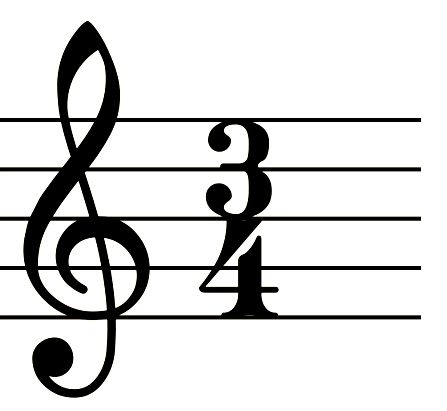
Top Figure Shows how many beats in a bar.
The bottom figure shows what kind of note is to be used to represent the beat. The most common are:
2 = minims = half notes
4 = crotchets = quater notes
8 = quavers = eighth notes
So if the time signature is 3/4, the 3 on the top would show that there are three beats in a bar and the bottom would show you that those three beats are quarter notes. Which means that one bar is 3 quarter notes long (3/4).
A piece can change time signature from bar to bar the whole piece does not have to be all the same time signature all the time.
Examples:
4/4: https://www.youtube.com/watch?v=OPf0YbXqDm0
3/4: https://www.youtube.com/watch?v=vGJTaP6anOU&list=PLM-jvmJAG4B-Js2QqB1RNFdr6UMbA71ZU
Change in time signature: https://www.youtube.com/watch?v=naoknj1ebqI
The verse is in 3/4 and the chorus is in 4/4. You can hear this change at (0:47)
Common and cut time
Time signatures were not always written in figures they used to be expressed as symbols such as circles and half circles, sometimes crossed with a vertical line, although most had disappeared out of use by the early 17th century. Except for two though in a modified form.

Referred to as Common time and means 4/4. It is called common time as 4/4 is the most common time signature used in Western music.

Referred to as Alla breve or Cut time and means 2/2. Cut time is twice as fast as common time.
This is an example of a piece going from common time to cut time.
Subdivisions
There are two ways for a beat to be subdivided in Western music. Either into 2 notes or into three smaller notes. All other subdivisions are either multiples of these two subdivisions or a complex form of adding them together.
Subdivisions can be put into 3 classifications.
- Simple time.
- Compound time.
- Irregular time.
Simple time
Simple time is any meter whose basic note division is in groups of 2. Examples of simple time: 4/4, 3/4, 2/4, 2/2, 2/1, Common time, Cut time. These are simple time because the whole note can be divides equally into 2 half notes, the half note can be divides equally into 2 quarter notes and the quarter note can be divides equally into 2 eighth notes.
Compound time
Compound time is any meter whose basic note division is in groups of three. If there is an 8 at the bottom of the time signature it is not going to be simple time. When there is an 8 on the bottom and a multiple of 3 on the top of the time signature the eighth notes should be grouped in groups of three.
6/8 = 2 groups of 3 eighth notes.
9/8 = 3 groups of 3 eighth notes.
12/8 = 3 groups of eighth notes.
Irregular time
Irregular or uneven time covers everything else. The most common irregular meters mix simple and compound time together in one measure. Which means that in each measure there are grouped in 3’s and 2’s.
Examples include: 5/8 and 7/8.
Since 5/8 and 7/8 have uneven and prime beats in a bar (top number on the time signature), they have to have a combination of groups of 3’s and 2’s to divide up the measure.


Evaluation
This week I focused on creating more content for the website and to promote on twitter. I used a combination of sources for the research on time signatures. I did this because the music theory book that I was using for research did delve too deep into time signature so I looked online for the information I needed. Writing it out into one post and making it not too complicated took awhile but other than that I ran into very few problems this week. I learnt about subdivisions, common and cut time whilst researching. Which is useful information to know as a musician.
I didn’t have enough time to create the youtube playlist that I was talking about last week so i’ll make sure to manage my time better next week in order to create that playlist.
References for Week 9
Aichele, M. (2018). Understanding Time Signatures and Meters: A Musical Guide. [online] Liberty Park Music. Available at: https://www.libertyparkmusic.com/musical-time-signatures/ [Accessed 20 May 2020].
Taylor, E. (2008). The AB guide to music theory. London: The Associated Board Of The Royal Schools Of Music.
Week 10
Music Content Playlist:
Basic Scales.

Evaluation
This week I focused on creating more posts for the website. I posted two new posts. The first being a youtube playlist containing lots of music theory videos and the second post being about Musical scales. Reflecting back on the project I am proud of the amount of content I have made for the website and the range of subjects I have covered. After finishing the two posts I put a link to it on twitter and got my friends to follow the twitter account. I also double checked the previous post I had on the website for any typos and to check if they were easy to read. In doing so i only came across a couple mistakes which I had to fix.
References for Week 10
Simplifyingtheory.com. (2019). Music Scales | Simplifying Theory. [online] Available at: http://www.simplifyingtheory.com/music-scales/.
Taylor, E. (2008). The AB guide to music theory. London: The Associated Board Of The Royal Schools Of Music.
Final Evaluation
Overall I think I was successful in creating my project, but I could’ve put more effort into the marketing side of the project. I completed most of the set goals I had set out for myself and adapted to problems that I came across well by asking others for help or researching a solution to the issue. Those are the main reasons why I managed to successfully complete this project also combined with all the experience and skills I’ve learnt from the other units, which I have used in order to achieve my goals for this project. Being in quarantine for the majority of this project made it more difficult to reach my weekly goals, since I am more restricted in my options and what I can do. But it also made it a lot easier to focus on the project as I had nothing else to do. In conclusion I am proud of how the project turned out considering the circumstances, but I do believe I could’ve focused on other areas on the project more than others like the marketing side.
 Jeremy's Music Blog